Ropilot vs Roblox Assistant: Which AI Should Script Your Game?
Roblox Assistant got serious in April 2026. With the "Studio is Going Agentic" release, the free first-party AI gained Planning Mode, mesh generation, and a beta Playtest Agent. Roblox says 44% of its top 1,000 creators now use Assistant or third-party AI tools over MCP. If you script on Roblox, AI assistance is no longer a niche workflow — it's the default.
So the honest question isn't "should you use AI in Studio?" It's "when is the free built-in Assistant enough, and when do you want more?" This page answers that with dated, checkable facts — including the cases where Assistant is genuinely the right choice.
Use Roblox Assistant for quick one-off scripts, explanations, and small fixes — it's free, built in, and improving fast. Use Ropilot when the task is a real feature on a real game: it runs frontier models (Claude Fable 5, Opus 5, Sonnet 5), reads your whole project, edits across files as reviewable diffs, and proves each change with an automated playtest before you ship it. Free to start, and the two tools coexist fine.
What Roblox Assistant does well
Credit where it's due — as of July 2026, Assistant's case is real:
- It's free and first-party. No install, no account beyond Roblox, no billing decision. It's already in your Studio.
- It went agentic in April 2026.Planning Mode analyzes your code and data model, asks clarifying questions, and turns big prompts into editable action plans. TechCrunch covered the release as a step toward end-to-end game development.
- It's starting to playtest. The Playtest Agent (Studio Beta, April 2026) reads output logs, captures screenshots, and drives inputs to check gameplay.
- It will keep improving. It's a first-party product with platform-level investment behind it.
If that covers your workflow, use it. No tool — ours included — deserves your money for jobs the free default already does well.
Where the trade-offs start
Three limits show up once you push past quick suggestions, each documented by Roblox or its own community:
- Daily quotas. Assistant has daily usage limits that Roblox doesn't publish as numbers. Creators report hitting the quota after a handful of questions, and a 2026 feature request asks Roblox to raise the limit. The Playtest Agent adds its own daily cap and a 50-turn abort limit. When you're mid-feature on a Saturday, a quota is a hard stop.
- You don't choose the model. Assistant runs whatever Roblox runs. Ropilot ships the frontier lineup on day one — Claude Fable 5, Opus 5, Sonnet 5, and Ropilot Advanced — and you pick per task. On code quality, the model is most of the outcome.
- The playtest loop is beta. Roblox's own beta announcement lists the current limitations plainly: "false passes," a need for very specific instructions, limited observability, and no real-time reflexes. That's a normal first version — and it's the part of the workflow where "first version" hurts most, because a false "Pass" is worse than no test at all.
What Ropilot does differently
Ropilot is built around one conviction: code isn't done until a playtest proves it works. That loop has been shipped in production, not beta:
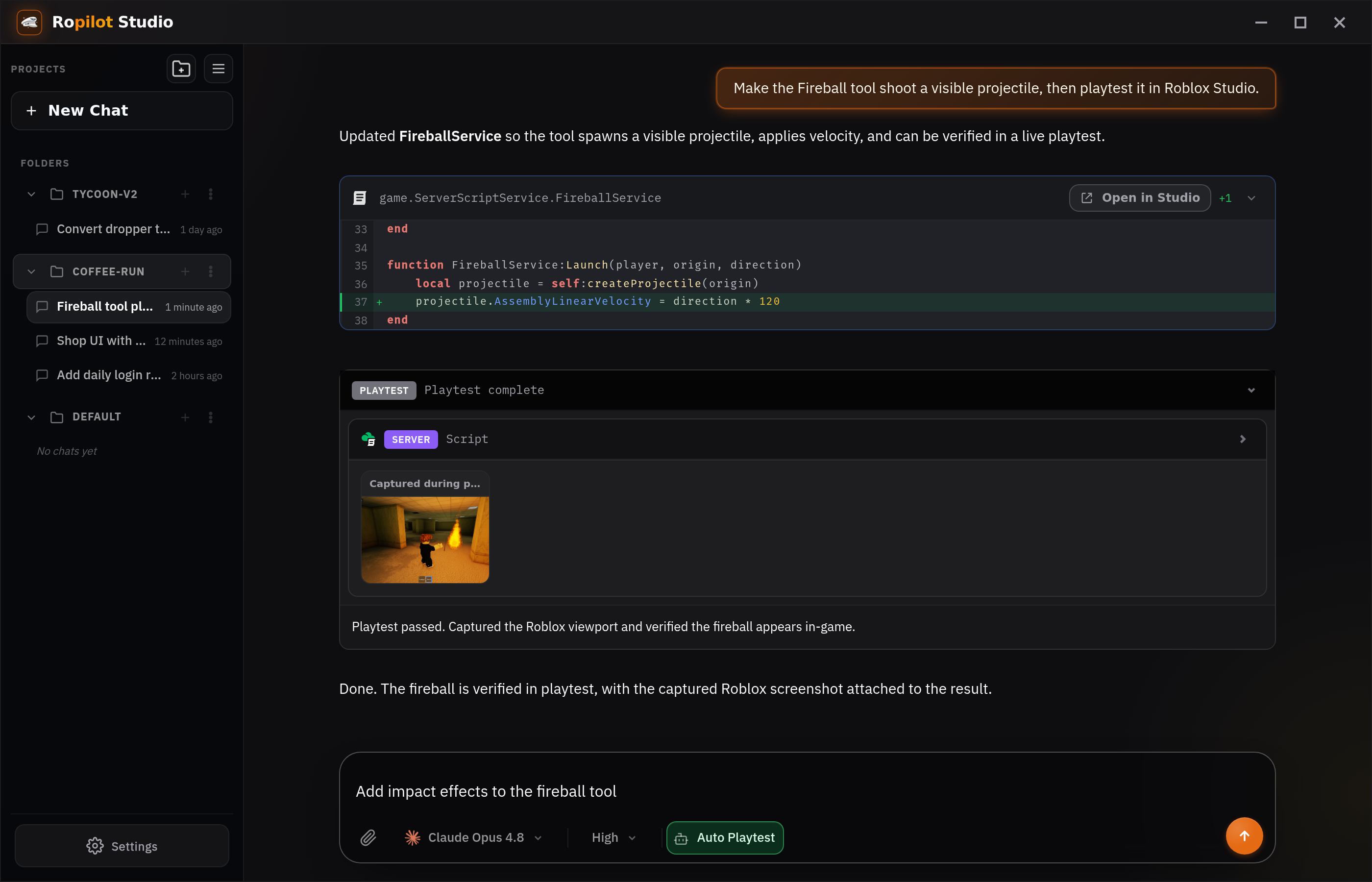
- Verified playtesting. Ropilot starts the playtest, simulates real input, captures the Roblox viewport, and checks server state — then reports "Playtest passed" with the receipts (screenshots and state checks), or goes back and fixes what broke. See it in the 90-second demo.
- Whole-game context. It reads your game tree and existing scripts, so changes reference the right instances and respect the architecture you already have — a live game, not a blank baseplate.
- Multi-file edits as reviewable diffs. A real feature touches a server script, a client script, and UI. Ropilot wires the whole change and shows you the diff before it lands.
- Frontier models, metered by use — not by the calendar. Pay with Ropilot Credits for exactly what you run, or bring your own Claude or ChatGPT plan. No daily wall in the middle of a build session.
- Free to start. No credit card. Download Ropilot Studio, connect the plugin, and run your first playtested feature.
Side-by-side
Both columns dated July 2026 — Assistant is a moving target, and we'd rather this table age honestly than read well.
| Dimension | Roblox Assistant | Ropilot |
|---|---|---|
| Price | Free (built into Studio) | Free to start; Ropilot Credits or bring-your-own Claude/ChatGPT plan for heavy use |
| Models | Roblox-selected; not user-choosable | Claude Fable 5, Opus 5, Sonnet 5, Ropilot Advanced — pick per task, available day one |
| Usage limits | Unpublished daily quotas; documented complaints of early cutoffs; Playtest Agent has its own daily cap + 50-turn limit | Metered by credits or your own plan; no daily cutoff |
| Playtesting | Playtest Agent — Studio Beta (opt-in), documented false passes and instruction sensitivity | Shipped verified loop: input simulation, viewport screenshots, server-state checks, pass/fail receipts |
| Project context | Analyzes code and data model in Planning Mode | Reads full game tree + scripts continuously; edits in-place across files with diffs |
| Setup | None — already in Studio | Desktop app + one-click Studio plugin (a few minutes) |
| Best at | Quick scripts, explanations, prototyping, zero-cost help | Real features on live games: multi-file changes, bug hunts, updates you ship tonight |
When to just use Assistant
Honestly — in these cases, don't pay for anything:
- You're learning Luau and want explanations and small examples on demand.
- You're prototyping on a fresh baseplate and quota resets don't hurt.
- You need a one-off snippet — a kill brick, a door, a simple tool — where a false start costs a minute, not an evening.
- Your studio policy is first-party tools only.
Ropilot earns its keep at the point where a wrong "looks done" costs you real players: the shop that eats purchases, the respawn bug that keeps a speed boost, the update you promised your community for the weekend. That's when a verified playtest stops being a feature and becomes the point.
The third option: Claude Code + Roblox's official MCP server
Full picture: Roblox also ships an official MCP server so agents like Claude Code, Cursor, and Codex can work with Studio directly — that's part of the 44% stat above, and for developers already living in a terminal it's a legitimate setup. You configure the tools, manage the connection, and build your own testing discipline around it.
Ropilot is the packaged version of that idea: the same frontier models, already wired to Studio, with the playtest-verification loop built in instead of left as an exercise. And because Ropilot speaks MCP too, choosing it doesn't lock you out of Claude Code or Cursor — bring your own plan and use both.
Test them yourself
Don't take a vendor's word for it — ours or anyone's. Run the same prompts through both and judge the results on your own game:
- Server shop: "Create a shop with three items. The client requests a purchase; the server validates cash, item IDs, and ownership before granting anything."
- The respawn bug: "Players keep a speed boost after respawn. Find the cause, fix it, and prove the speed resets."
- Mobile UI: "Add a cash counter and shop button that don't overlap on phone screens."
- The proof: After each task, ask: did the tool show me it works — or did it tell me it should?
That last question is the whole comparison in one line.
Bottom line
Roblox Assistant is a good free default that got meaningfully better in April 2026, and for quick scripting help it's all many creators need. Ropilot is for the moment your game becomes real: frontier models you choose, whole-project context, reviewable multi-file changes, and a playtest loop that proves the fix instead of predicting it. Assistant suggests. Ropilot proves.

Ship a playtest-proven feature tonight
Describe the feature. Ropilot reads your game, writes the Luau, runs the playtest, and shows you it works — free to start, no credit card.
Get started free